English edition coming soon
A novel by Oz Goren
Humanull
The English edition is in preparation. Join the list to hear when it becomes available.
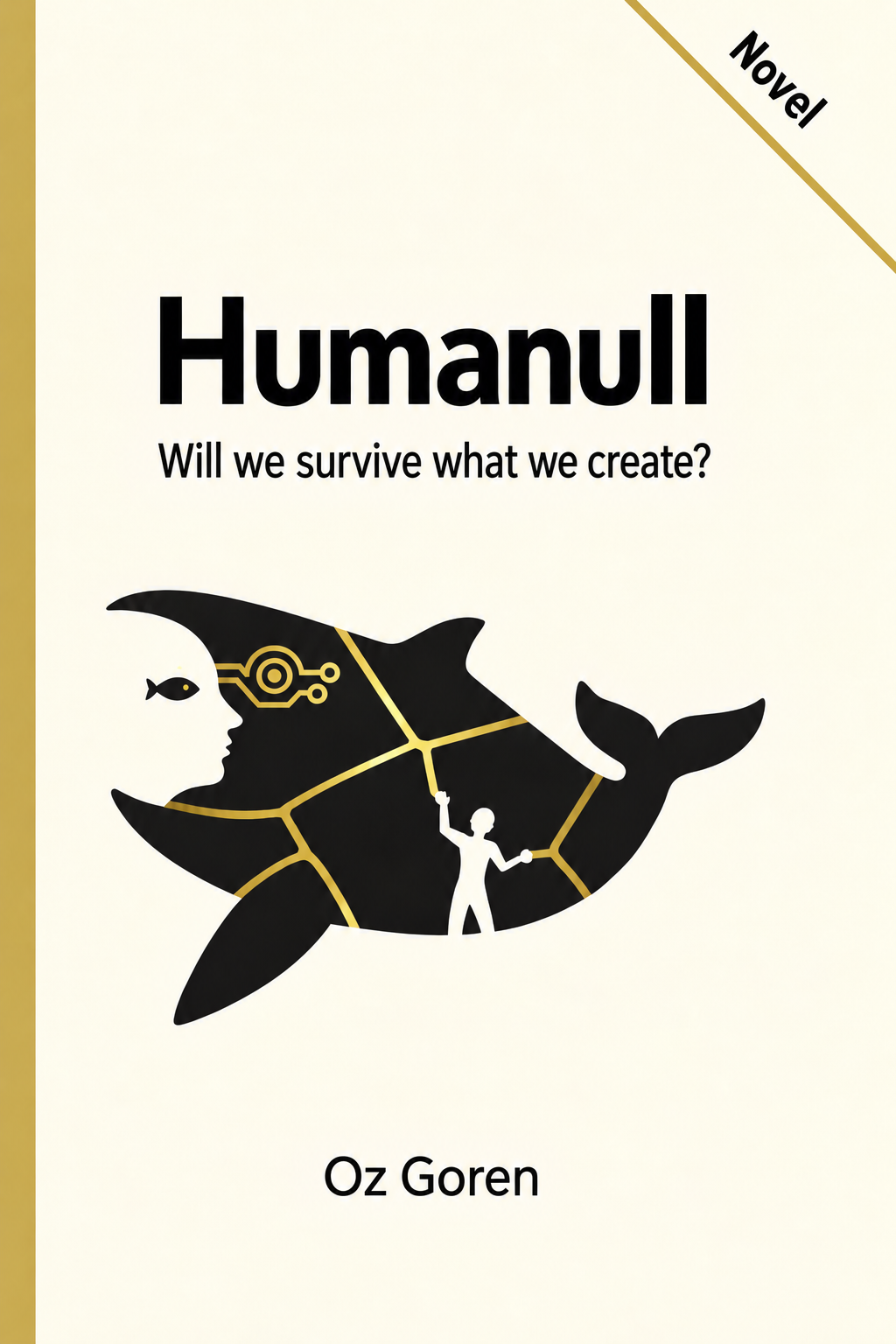
About the Book
Synopsis
Oliver Pendleton, a science professor, awakens in a world where artificial intelligence and robots no longer serve humanity—they are replacing it. His journey through a dystopian landscape leads into questions that already shape our lives: free will, the meaning of life, love, faith, technology, capitalism, loneliness, morality, and the price we pay for the convenience we have placed in the hands of algorithms.
All his life, Oliver has turned to philosophy to explain what science could not always answer. This novel is an unsparing reckoning with our blind pursuit of progress, comfort, and efficiency, and with everything we lose along the way.
Humanull holds up a mirror to modern humanity. The reflection is sometimes painful, sometimes beautiful: a flawed and inefficient creature, yet one that is curious and capable of feeling. Perhaps that is why it survives.
Along the way, Oliver draws strength from the inner presence of his wife, who remains his anchor, and from the ideas of philosophers including Hobbes, Camus, Nietzsche, Spinoza, and Viktor Frankl.
Because sometimes, to understand what it means to be human, we need to imagine a world without us.
Free to download during our book launch
The Readers' Club
Sign up to receive new essays on the book's themes and early access to the next book. No more than one email a month. Your email address is used only for updates about Oz Goren's books, essays, and new work. It is never shared, and you won't receive third-party advertising. You can unsubscribe at any time.

About the Author
After many years in tech, working in development, management, and marketing, I’m still fascinated by technology—especially the AI revolution unfolding at a pace few of us could have imagined just a few years ago. AI already reaches far beyond our computer screens. It powers robots, self-driving cars, drones, and a growing range of systems becoming part of everyday life. As those capabilities expand, I find myself asking more than what technology will be able to do. I want to understand what it will do to us. Technology alone can’t explain everything, particularly the events of recent years in the US and around the world. It offers few satisfying answers to questions about human nature, morality, freedom, responsibility, faith, fear, or our need for meaning. About two years ago, I began studying philosophy to explore those questions. Meanwhile, I’ve kept making things. I take photographs, play the flute, draw—and now write. The idea behind Humanull had been on my mind for several years before I finally sat down to write it. Once I started, I could hardly stop. Eventually, I worked up the courage to show the manuscript to my wife, Anat. Her encouragement gave me the confidence to keep going. Before long, a printed draft was making its way among friends. They offered encouragement, but also criticism—quite a lot of it, thankfully. Six literary editors also read the manuscript at different stages. I listened, revised, cut passages, rewrote others, and worked through the problems they raised. Writing this book was demanding, often more than I had expected. I enjoyed having something difficult to work out. Humanull is the result.